

Every November, the town of Plymouth, Massachusetts, appears on news reports and greeting cards as the birthplace of Thanksgiving. Behind that cheerful picture is an older and darker place: a town whose first winter killed half of its settlers, whose hillside cemetery holds more than two thousand marked graves, and whose bay once held a stranded ship full of frozen sailors.
It is no surprise that Plymouth has some of the best-known ghost stories in New England, and lantern-lit ghost walks that wind through its old streets. This Thanksgiving week, here is the real history of haunted Plymouth, from Burial Hill to a witch's curse, and the part of the Thanksgiving story that is too often left out.
Quick facts
- Where: Plymouth, Massachusetts, about 40 miles south-east of Boston
- Founded: by the Mayflower passengers in December 1620
- First winter: 52 of the 102 colonists died between 1620 and 1621
- Most haunted spot: Burial Hill, the town's historic cemetery, with more than 2,000 marked graves
- Darkest night: December 1778, when around 70 sailors from the privateer General Arnold froze to death in Plymouth Bay
- On Thanksgiving Day: Native Americans gather on Cole's Hill for the National Day of Mourning, held every year since 1970
The first winter
The Mayflower passengers came ashore at Plymouth in December 1620, far too late in the year to build proper shelter or plant crops. They were cold, malnourished and sick, and disease spread fast through the crowded ship and the first rough houses. By the spring, 52 of the 102 colonists were dead.
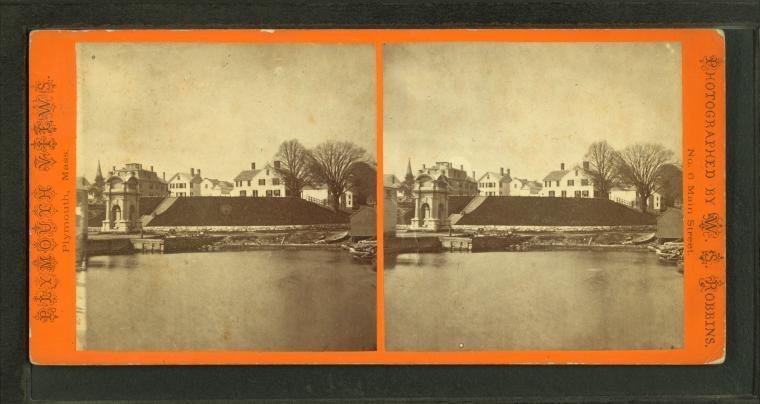
They were buried on Cole's Hill, the slope that rises above the harbour where Plymouth Rock sits today. Historians believe the hill holds between 45 and 50 burials from that terrible winter. Over the following centuries, bones kept turning up as the ground was dug and eroded, and in 1920 the remains that had been found were placed in a granite sarcophagus that still stands on the hill.
The "first Thanksgiving", and the other side of the story
The settlers who survived owed a great deal to their Wampanoag neighbours, who showed them how to grow local crops. In the autumn of 1621, after the first harvest, the colonists held a celebration. One of them, Edward Winslow, described it in a letter: "many of the Indians coming amongst us, and among the rest their greatest king Massasoit, with some ninety men, whom for three days we entertained and feasted". That gathering is what Americans now remember as the first Thanksgiving, although the national holiday only began in 1863.
The peace did not last. Within two generations, colonial expansion led to King Philip's War (1675–1676), one of the bloodiest conflicts in early American history. Metacom, Massasoit's son, known to the English as King Philip, was killed in 1676. His body was quartered, and his head was displayed on a pike in Plymouth for more than twenty years.
That history is why, for many Native Americans, Thanksgiving is not a celebration. In 1970, the Wampanoag leader Wamsutta Frank James was invited to speak at an event marking 350 years since the Pilgrims' arrival. When the organisers saw his speech, which spoke about the suffering of his people, they withdrew the invitation. He gave it instead on Cole's Hill, beside the statue of Massasoit. That was the first National Day of Mourning. It has been held on Cole's Hill every Thanksgiving Day since, organised by the United American Indians of New England, and a plaque on the hill now marks it.
Burial Hill
A short walk uphill from the waterfront is Burial Hill, the heart of Plymouth's haunted reputation. The Pilgrims built a fort on top of it in 1621 and 1622, which also served as their meeting house. Later it became the town's main cemetery. Today it covers about five acres and holds more than 2,000 marked graves, dating from 1680 to 1957, among them the monument to Governor William Bradford and the graves of several Mayflower passengers, including John Howland.
On a grey November afternoon, with the slate headstones leaning in every direction and the harbour spread out below, it is easy to see why the hill has gathered ghost stories. Local ghost-tour guides say visitors have seen figures in Pilgrim clothing walking among the stones, and Victorian-era parents kneeling at the graves of their children. Some guides explain it simply: in early Plymouth, people often died young and suddenly, and many of them, the story goes, had unfinished business.
The frozen sailors of the General Arnold
The most haunting story on Burial Hill is completely true.
On Christmas Eve, 1778, in the middle of the American Revolution, the privateer General Arnold left Boston under Captain James Magee, bound for the West Indies to hunt British merchant ships. She had barely cleared the coast when a ferocious blizzard drove her into Plymouth Bay. Dragging her anchor, she ran aground on the White Flats around dawn on December 26.
The storm was so violent that the people of Plymouth could not reach the ship for days. The crew huddled on the deck as the sea broke over them and the cold set in. By the time rescuers got through, around seventy men had frozen to death. Accounts differ on the exact numbers, but only a few dozen survived, Captain Magee among them.
Most of the dead were buried together in a mass grave on Burial Hill. For decades it had no proper marker. In 1862, a visitor who heard the story paid for an obelisk to be raised over the grave. When James Magee died in 1801, aged 51, he was brought back to Plymouth and buried on Burial Hill with his men, and his name was later added to the monument. Tour guides say a figure has been seen standing by the obelisk at night, and that it is Magee, still keeping watch over his crew.
Mother Crewe's curse
Burial Hill also has a witch. According to Plymouth legend, a man named Thomas Southward Howland tried to evict an old woman from a shack on his land. The woman, remembered in local lore as Mother Crewe and said to be a witch, refused to go quietly. She warned him: "Make your peace because you will not live to see another sunset."
The next day, the story says, Howland was thrown from his horse and killed, and the gravediggers were soon at work in his family's plot on Burial Hill. It is a folk tale rather than recorded history, but it is one of the stories Plymouth's ghost walks still tell beside the Howland graves.
Plymouth's other haunts
Ghost-tour guides in Plymouth point to several other buildings around the old town centre. These are local legends, passed on by guides and visitors, but they are part of the town's character:
- The 1749 Court House on Town Square, one of the oldest wooden courthouses in the country, where spirits are said to pull back the window shades and look out at the square.
- The John Carver Inn, built on the site of an earlier house where, according to local tradition, medical students in the Revolutionary era robbed nearby graves for bodies to practise on, until the townspeople drove them out. Guides say guests on the third floor have been disturbed ever since.
- Old houses along the historic streets, several of which tour companies describe as having "reported paranormal activity".
Our take
Plymouth's ghost stories are entertaining, but what gives the town its weight is the real history underneath them: a winter that killed half a settlement, a peace that collapsed into war, a head on a pike, and seventy sailors who froze within sight of shore on a December night. If you visit this Thanksgiving, the most powerful moment may not be a ghost walk at all, but standing on Cole's Hill, where the Pilgrims buried their dead and where, every Thanksgiving Day, Native Americans gather to remember theirs.
Visiting haunted Plymouth
Burial Hill is behind the First Parish Church at the top of Town Square and is open to visitors; take care on the uneven ground and treat it as the working cemetery and historic site it is. Cole's Hill is across the road from Plymouth Rock on the waterfront. Several local companies run evening ghost walks through the old town, especially in the autumn, so check what is running before you go. For the history, the Pilgrim Hall Museum and Plimoth Patuxet Museums are both nearby.
If you are visiting on Thanksgiving Day, remember that Cole's Hill will be the site of the National Day of Mourning, a solemn gathering rather than a tourist event.
Massachusetts is also home to Salem, whose own dark history we cover in the Salem witch trials. For more haunted places in the United States, see the most haunted places in America, or find the ones closest to you on our haunted places map.
Frequently asked questions
Is Plymouth, Massachusetts, haunted?
Plymouth has a strong ghost-story tradition, centred on Burial Hill, the 1749 Court House and the mass grave of the General Arnold sailors. The stories are local legend, but the history behind them is real.
What is Burial Hill?
Plymouth's historic hilltop cemetery, on the site of the Pilgrims' first fort and meeting house. It has more than 2,000 marked graves from 1680 to 1957, including Governor William Bradford's monument.
What happened to the General Arnold?
The privateer ran aground in Plymouth Bay during a blizzard on December 26, 1778. Rescuers could not reach her for days, and around 70 of her crew froze to death. Most are buried in a mass grave on Burial Hill.
How many Pilgrims died in the first winter?
Fifty-two of the 102 colonists died during the winter of 1620–1621. Most were buried on Cole's Hill.
What is the National Day of Mourning?
An annual gathering on Cole's Hill on Thanksgiving Day, held since 1970 and organised by the United American Indians of New England, to remember the Native peoples who suffered and died as a result of European colonisation.


Leave a Reply
Your email address will not be published. Comments are moderated before they appear.