

At about ten past seven on the evening of November 10, 1975, the crew of the freighter Arthur M. Anderson radioed the ship a few miles ahead of them on Lake Superior to ask how she was doing. Captain Ernest McSorley's reply was short and calm: "We are holding our own."
About ten minutes later the Edmund Fitzgerald was gone. Her echo simply faded off the Anderson's radar screen. There was no mayday, no flare and no last message. All 29 men aboard died, and not one of them was ever brought home.
More than half a century later, the wreck lies broken in two on the bottom of the lake, and people still argue about what sank her. This is what is known for certain, what is still disputed, and why this shipwreck has never been allowed to fade into history.
Quick facts
- When: November 10, 1975, shortly after 7:10 p.m.
- Where: eastern Lake Superior, about 17 miles north-northwest of Whitefish Point, Michigan, just inside Canadian waters
- Depth: about 530 feet (160 metres)
- Lost: all 29 crew members, aged 20 to 63
- The ship: a 729-foot lake freighter, the largest on the Great Lakes when she was launched in 1958
- Cargo: 26,116 long tons of taconite iron-ore pellets
- Cause: still disputed
The "Mighty Fitz"
When she slid into the water at River Rouge, Michigan, on June 7, 1958, the Edmund Fitzgerald was the biggest ship on the Great Lakes: 729 feet long and 75 feet wide. She belonged to the Northwestern Mutual Life Insurance Company of Milwaukee, took her name from the man at the head of the company, and was run under contract by the shipping firm Oglebay Norton.
For the next 17 years she carried iron ore from the mines around Lake Superior to the steel mills further down the lakes. She set seasonal haul records six times, and the men who worked on and around her called her the "Mighty Fitz" or the "Big Fitz". She is still the largest ship ever lost on the Great Lakes.
The last voyage
The Fitzgerald left Superior, Wisconsin, at 2:15 p.m. on Sunday, November 9, 1975. Her holds were full of 26,116 long tons of taconite pellets bound for a steel mill on Zug Island, near Detroit.
In command was Captain Ernest McSorley, 63, a veteran master with a reputation as a heavy-weather captain. One former crewman, George Burgner, later said McSorley "very seldom ever hauled up for weather". The youngest man aboard, watchman Karl Peckol, was 20.
Later that day the Fitzgerald fell in with a second freighter, the Arthur M. Anderson, under Captain Jesse "Bernie" Cooper, which was bound for Gary, Indiana. The two ships would cross the lake together.
The forecast that day said a November storm would pass just south of Lake Superior. It didn't. By 7 p.m. the National Weather Service had put out gale warnings for the whole lake, and at 2 a.m. on November 10 they were upgraded to storm warnings. The two captains chose a more northerly route, closer to the Canadian shore, hoping it would give them some shelter.
November 10, 1975: the last afternoon
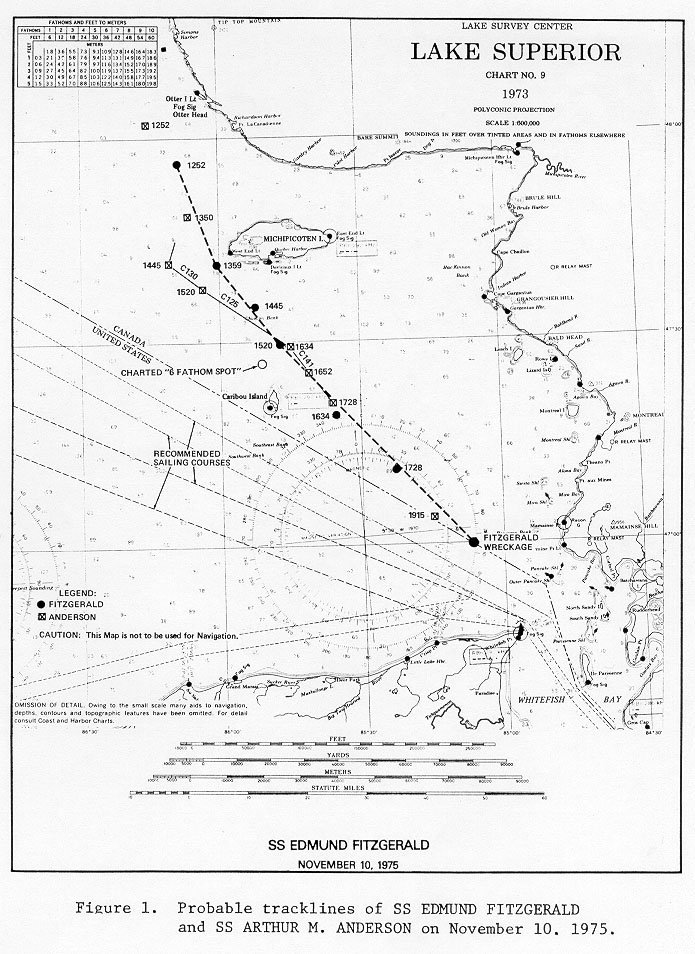
By the afternoon of the 10th the storm was at full strength. The Anderson logged sustained winds of up to 58 knots, about 67 miles per hour, and waves of around 25 feet. Here is how the last hours unfolded, pieced together from the official investigations:
- About 3:30 p.m. McSorley radioed the Anderson to say the Fitzgerald was taking on water. She had lost two vent covers and a fence railing and had developed a list to starboard.
- Just after 4:10 p.m. He reported that his radar had failed and asked the Anderson to keep track of the Fitzgerald.
- 4:39 p.m. McSorley called the Coast Guard station at Grand Marais to ask whether the light and radio beacon at Whitefish Point, the landmark he needed to find shelter, were working. The Coast Guard's equipment showed that both were out. (Another captain nearby later said the light was on but the beacon was not.)
- Between 5:00 and 5:30 p.m. Speaking to Captain Cedric Woodard of the Avafors, McSorley said: "I have a 'bad list', I have lost both radars, and am taking heavy seas over the deck." He called it one of the worst seas he had ever been in.
- About 6:30 p.m. Captain Cooper reported seas of 30 to 35 feet hitting the Anderson.
- About 7:10 p.m. The Anderson radioed the Fitzgerald. The answer was "We are holding our own." Nobody heard from her again.
- About 7:20 p.m. The Fitzgerald disappeared from the Anderson's radar. No distress call was ever received.
The search
Captain Cooper first contacted the Coast Guard at 7:39 p.m. and reported the Fitzgerald missing at 9:03 p.m. The Anderson went back out into the storm to search, along with the freighter William Clay Ford, the Coast Guard buoy tender Woodrush, a Coast Guard aircraft and, after midnight, a helicopter.
Over about three days they found only wreckage, including the Fitzgerald's lifeboats and life rafts. No one was found alive, and no bodies were recovered.
On November 14, a U.S. Navy P-3 Orion aircraft found the wreck by flying over the area with a magnetic anomaly detector, an instrument normally used to hunt submarines. In May 1976 the Navy sent down its unmanned submersible CURV-III. Its cameras showed the ship in two large pieces about 170 feet apart: the bow sitting upright in the mud, and the stern lying upside down.
What sank the Edmund Fitzgerald?
With no survivors and no distress call, every explanation is a reconstruction. Five main theories have been argued over since 1975.
1. Leaking hatch covers
The U.S. Coast Guard's report, published on July 26, 1977, concluded that the hatch covers on the cargo holds had not been properly secured. Water seeped in through the afternoon until the ship lost so much buoyancy and stability that she plunged to the bottom.
2. Collapsing hatch covers
The National Transportation Safety Board, reporting on May 4, 1978, put it slightly differently: one or more hatch covers gave way under the waves breaking over the deck, and the hold flooded suddenly. The NTSB also concluded that the Fitzgerald sank in one piece and broke apart on or near the bottom.
3. A brush with the Six Fathom Shoal
The Lake Carriers' Association, which represents Great Lakes ship operators, rejected the hatch-cover theories. It argued that the Fitzgerald scraped the Six Fathom Shoal near Caribou Island that afternoon, tearing her hull and causing the list McSorley reported. A Canadian survey in 1976 found that the shoal lay about a mile further east than the charts showed.
4. The "three sisters"
Great Lakes sailors talk about the "three sisters", a run of three huge waves that hit one after another before the water from the first has drained off the deck. Captain Cooper's report of 30- to 35-foot seas around 6:30 p.m. is often cited as evidence that a set like this reached the Fitzgerald shortly before she sank.
5. A weakened hull
Some former crew members, and the naval architect Raymond Ramsay, argued that the ship's hull had been weakened over the years. Ramsay concluded that the Fitzgerald was not seaworthy on November 10, 1975.
If you ask us, the honest answer is probably several of these at once: a fully loaded ship, a storm the forecast got wrong, a damaged and listing hull, no radar, a dark radio beacon, and waves big enough to bury a deck that was already taking water. What finally happened in those last minutes is something only the 29 men aboard ever knew.
"The lake never gives up her dead"
None of the 29 crew members was ever recovered. Gordon Lightfoot's famous song repeats an old saying that Lake Superior never gives up her dead, and there is some science behind it. The lake's deep water stays very cold all year, below about 40°F (4°C). The cold slows down the bacteria whose gases would normally bring a drowned body back to the surface.
The saying is more folklore than a law of nature, but for the men of the Fitzgerald it held true. In 1994, an expedition led by Fred Shannon found the remains of a crew member near the bow, still wearing a life jacket. For the families it was a painful reminder that the wreck is a grave. Ontario later changed the law to protect it: since 2006 there has been a 500-metre protected zone around the wreck, diving or surveying there needs a licence, and the fines run up to a million Canadian dollars.
Ghost ships and the lake's dark reputation
Lake Superior had ghost-ship stories long before 1975. Sailors told of the Bannockburn, a Canadian freighter that vanished on the lake decades before the Fitzgerald and was later said to reappear as a phantom, the "Flying Dutchman of Lake Superior".
Since the Fitzgerald went down, plenty of websites have claimed that people have seen her too, sailing through the storm. We went looking, and we could not find a single first-hand, documented sighting. Most versions trace back to blogs and podcasts retelling each other.
What is real is eerie enough on its own: a light and radio beacon that went dark on the one night they were needed most, a 729-foot ship that slipped off a radar screen without a word, and a bell that is still rung for her crew every November 10.
How the Fitzgerald is remembered
The day after the sinking, the Mariners' Church in Detroit rang its bell 29 times, once for each man lost. It kept doing so every year until 2006, when the ceremony was widened to remember everyone who has died on the Great Lakes. On May 2, 2023, the church rang the bell 30 times: 29 for the crew and once for Gordon Lightfoot, who had died the day before.
The Fitzgerald's own bell was brought up from the wreck on July 4, 1995, at the request of the crew's families. A replica engraved with the names of the 29 men was left in its place. The original now hangs at the Great Lakes Shipwreck Museum at Whitefish Point, Michigan. Every November 10, family members ring it once for each of their lost loved ones, 29 times in all, and a 30th ring is for everyone else the Great Lakes have taken.
On the Minnesota shore, Split Rock Lighthouse near Silver Bay lights its beacon in the ship's honour every November 10.
Then there is the song. Gordon Lightfoot read about the wreck in a Newsweek article, "The Cruelest Month", and wrote "The Wreck of the Edmund Fitzgerald" for his 1976 album Summertime Dream. Released as a single in August 1976, it went to number one in Canada and number two on the US Billboard Hot 100. Lightfoot wrote it before the wreck had been properly studied and admitted he took some artistic liberties. In March 2010, after a documentary suggested that the waves, not the crew, were to blame, he started singing a changed line about the ship's final moments at his concerts.
The sinking also changed the rules on the Great Lakes:
- Depth finders became compulsory on large ships in 1977.
- Survival suits, with strobe lights on suits and life jackets, became compulsory in 1980.
- Emergency position-indicating radio beacons (EPIRBs) were fitted to Great Lakes vessels.
- The charts for north-eastern Lake Superior were improved, and NOAA changed how it predicts wave heights.
- The Coast Guard began yearly inspections before November, checking hatch and vent closures and life-saving equipment.
Can you visit the Edmund Fitzgerald?
Not the wreck itself. She lies 530 feet down in protected Canadian waters, and as a grave site she is off limits without a licence.
You can see her bell at the Great Lakes Shipwreck Museum at Whitefish Point, Michigan, about 17 miles from where she sank. The bow anchor she lost on an earlier trip in 1974 is on display at the Dossin Great Lakes Museum in Detroit. Check opening times before you travel.
If places with stories like this one draw you in, our map of haunted places near you shows haunted and unexplained locations around the world, each linked to its story. For another ship whose crew met a terrible end, read the SS Ourang Medan mystery, and for an American aircraft that came back with nobody on board, read about the Ghost Blimp.
Frequently asked questions
When did the Edmund Fitzgerald sink?
On November 10, 1975, shortly after 7:10 p.m., during a severe storm on Lake Superior.
How many people died on the Edmund Fitzgerald?
All 29 crew members died. There were no survivors.
What was the last message from the Edmund Fitzgerald?
"We are holding our own," sent by Captain Ernest McSorley in reply to a radio call from the Arthur M. Anderson at about 7:10 p.m.
Why were no bodies ever recovered?
The wreck lies about 530 feet down in very cold water, which slows decomposition and keeps bodies from rising. The site is also treated as a grave and protected by Ontario law, so it cannot be searched or disturbed without a licence.
Where is the wreck of the Edmund Fitzgerald?
In eastern Lake Superior, about 17 miles north-northwest of Whitefish Point, Michigan, just inside Canadian waters, at a depth of about 530 feet.
Can you dive to the Edmund Fitzgerald?
Not without a licence from the Province of Ontario. Since 2006 the wreck has been surrounded by a 500-metre protected zone, with fines of up to CA$1 million.
Sources
- National Transportation Safety Board: Marine Accident Report, SS Edmund Fitzgerald sinking in Lake Superior on November 10, 1975 (1978)
- Great Lakes Shipwreck Museum: Edmund Fitzgerald
- Upper Michigan's Source: 50th anniversary bell ceremony held for Edmund Fitzgerald (2025)
- EarthSky: the sinking of the Edmund Fitzgerald and why the lake "never gives up her dead"
- Wikipedia: SS Edmund Fitzgerald
- Wikipedia: The Wreck of the Edmund Fitzgerald (song)


Leave a Reply
Your email address will not be published. Comments are moderated before they appear.