

On the night of November 15, 1966, two young married couples from Point Pleasant, West Virginia, were driving through an abandoned wartime explosives plant just outside town when they saw something in the dark. It was shaped like a man, but taller. It had wings. And it had two eyes that, as they later told the police, "glowed red".
Roger and Linda Scarberry and Steve and Mary Mallette did not stay to look. They said they floored it, reaching 100 miles an hour, and that the thing kept pace with them, screeching, until they reached the edge of town. By the next afternoon their story was in the local paper. Within weeks the creature had a name: the Mothman.
Sixty years on, Point Pleasant has a twelve-foot steel statue of it, a museum and a festival that draws thousands of visitors every September. But behind the souvenir shops is a stranger and sadder story: a run of sightings that ended, thirteen months later, with one of the worst bridge disasters in American history. This is what actually happened, what the witnesses said, and what the creature might really have been.
Quick facts
- First widely reported sighting: the night of November 15, 1966
- Where: the "TNT area", a former World War II munitions plant north of Point Pleasant, Mason County, West Virginia
- Witnesses: Roger and Linda Scarberry, Steve and Mary Mallette
- What they described: a winged, man-shaped figure about seven feet tall with glowing red eyes
- First headline: Point Pleasant Register, November 16, 1966: "Couples See Man-Sized Bird ... Creature ... Something"
- Linked tragedy: the Silver Bridge collapse, December 15, 1967, which killed 46 people
- Most likely explanation: a large bird, probably an owl or a crane, though believers disagree
The TNT area
To understand why the sightings felt so frightening, you have to picture where they happened. During the Second World War, the U.S. government built the West Virginia Ordnance Works on more than 8,000 acres of farmland north of Point Pleasant. Between 1942 and 1945 it made TNT, and at its peak it employed about 3,500 people.
When the war ended, the plant closed. Part of the land became the McClintic Wildlife Management Area, but dozens of the concrete igloos used to store explosives were left standing in the woods, half-buried and empty. By the 1960s the "TNT area", as locals called it, was a maze of dirt roads, ponds and abandoned bunkers, the kind of place teenagers drove out to at night. (Years later it would turn out to be contaminated too: in the late 1970s fishermen reported red water seeping into the ponds, and in 1983 the old plant was listed as a federal Superfund clean-up site.)
That is where the Scarberrys and the Mallettes were driving that November night.
November 15, 1966: the first sighting
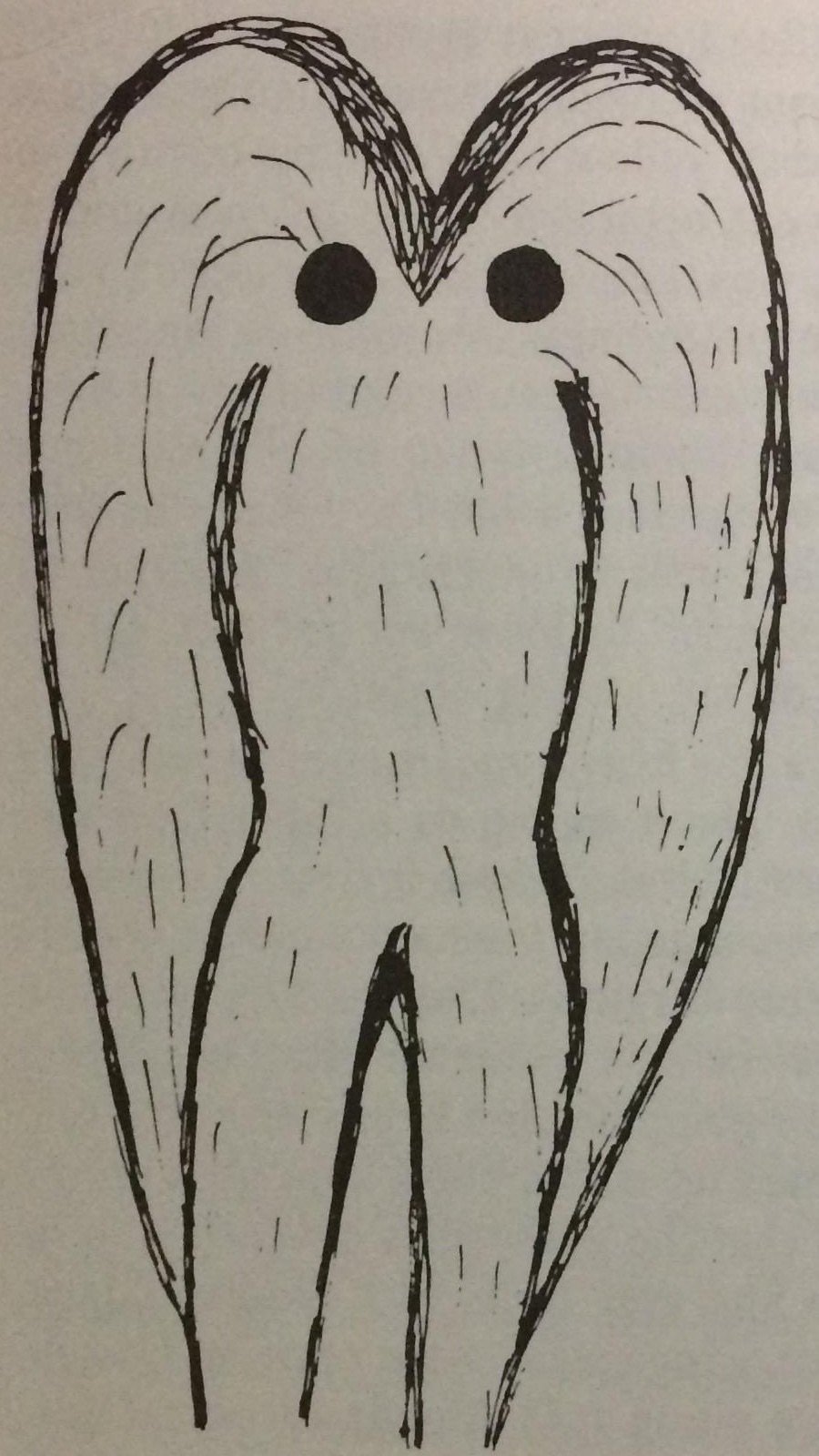
According to the accounts the four gave afterwards, Linda Scarberry described the figure as a "slender, muscular man" about seven feet tall, with white wings. She could not make out a face. What everyone remembered were the eyes, which they said glowed red.
The couples fled for town. They said the creature followed them, screeching, and kept up even as they pushed past 100 miles an hour. It only fell back when they reached the Point Pleasant city limits.
The four went to the police and reported what they had seen. Whatever it was, they were badly shaken by it.
A name, and a flood of sightings
On November 16, the Point Pleasant Register ran the story under a headline that summed up everybody's confusion: "Couples See Man-Sized Bird ... Creature ... Something". Over the following days, other people came forward to say they had seen a large winged figure around the TNT area and along the Ohio River.
The name "Mothman" appeared in newspaper coverage soon afterwards. Nobody seems to know exactly who first used it, but Batman was one of the most popular shows on American television in 1966, and the comic-book flavour of the nickname was hard to miss. It stuck.
One earlier report also surfaced. A man named Kenneth Duncan said that on November 12, three days before the Scarberrys' sighting, he and other men digging a grave at a cemetery near Clendenin, in Kanawha County, had seen a human-like shape glide through the trees above them. He only spoke up after he read about the Point Pleasant couples. Whether he saw the same thing, a large bird or, as one local writer has suggested, a startled flying squirrel, nobody can say.
How many sightings followed is hard to pin down. Popular books often claim that more than a hundred people saw the Mothman over the next year. The folklorist Jan Harold Brunvand has pointed out that those counts come from sources that are not very reliable. What is certain is that for about thirteen months, Point Pleasant had a monster, and plenty of people were afraid to drive out to the TNT area after dark.
The Silver Bridge
On December 15, 1967, the Silver Bridge, which carried U.S. Route 35 across the Ohio River between Point Pleasant and Gallipolis, Ohio, collapsed during the evening rush hour. Thirty-two vehicles went down with it. Forty-six people died. Two of them, Kathy Byus and Maxine Turner, were never found.
The cause, established by federal investigators, had nothing to do with the supernatural. The 1928 suspension bridge hung from chains of steel eyebars, and one of them, eyebar 330, had a tiny crack, about a tenth of an inch deep. Wear and corrosion had grown the crack over the years until the bar snapped. Because each link of the chain had only two eyebars, the second one could not carry the load alone, and the bridge came down while carrying less than half of the weight it was designed for.
The disaster changed America's roads. It led directly to the first national bridge inspection program, created under the Federal-Aid Highway Act of 1968. A replacement crossing, the Silver Memorial Bridge, opened downstream exactly two years later, on December 15, 1969.
For a town already living with a monster story, the timing was impossible to ignore. Reported sightings of the Mothman largely stopped after the collapse, and some people began to ask whether the creature had been trying to warn them.
John Keel and "The Mothman Prophecies"
The man who turned that question into a legend was John Keel, a New York writer who travelled to Point Pleasant to interview witnesses. In Operation Trojan Horse (1970) and then The Mothman Prophecies (1975), he tied the Mothman to a whole web of strange events: UFO sightings, visits from "men in black" and premonitions of disaster, with the bridge collapse as the climax.
Keel's book made Point Pleasant famous far beyond West Virginia, and in 2002 it was turned into a Hollywood film, The Mothman Prophecies, starring Richard Gere. It is worth remembering, though, that Keel was a storyteller writing years after the events, and that many of the connections he drew exist only in his books. The idea that the Mothman "predicted" the collapse came later. Nobody in 1967 was warning anyone about eyebar 330.
So what did they see?
Several down-to-earth explanations were offered at the time and since:
- A heron. Sheriff George Johnson thought the witnesses had seen an unusually large heron. Writer Daniel A. Reed later argued that, in reports where nobody mentioned glowing eyes, a great blue heron was the most likely candidate.
- A sandhill crane. Robert L. Smith, a wildlife biologist at West Virginia University, said the descriptions matched a sandhill crane that had wandered off its migration route. Sandhill cranes can stand around four feet tall, have wingspans of up to about seven feet, and have a patch of bright red skin on the forehead.
- An owl. The investigator Joe Nickell believes the witnesses saw a barred owl. He points out that an owl's eyes can reflect a car's headlights so that they seem to glow, and a big owl swooping at a car at night can look far larger than it is.
- A snowy owl. In 1966 a local man, Ace Henry, shot a large snowy owl in the area. That bird is now on display at the Mothman Museum, as a possible culprit.
Our take: the bird explanations fit the first sightings well, especially the glowing eyes, which is exactly what animal eyeshine looks like. They fit less neatly with the witnesses' insistence on a man-shaped body and a car chase at 100 miles an hour. But fear, darkness and a car full of terrified people are a powerful combination, and once a monster is in the newspaper, every large bird becomes a sighting. What turned a scary night into a lasting legend was not the creature itself but what came after: Keel's books, and a real tragedy that gave the story a dark ending.
Point Pleasant today
Point Pleasant has embraced its monster. In 2003 the town unveiled a twelve-foot metal statue of the Mothman, made by the sculptor Bob Roach, with wings and red eyes. The Mothman Museum and Research Center opened in 2006; among its exhibits is Ace Henry's snowy owl.
Since 2002, the town has also held a Mothman Festival every year, now on the third weekend of September. Its organiser, Jeff Wamsley, estimates that 10,000 to 12,000 people come each year, to a town of only a few thousand residents.
The TNT area is still there too, now part of the McClintic Wildlife Management Area. Some of the old explosives igloos still stand in the woods, and they draw Mothman fans who want to see where it all began. If you go, remember that it is a working wildlife area, so check access rules and hunting seasons first.
The Mothman is one of the places on our haunted places map, where you can find haunted and unexplained locations near you. If you like Appalachian folklore, our post on the dark legends of the Appalachian Mountains covers the Mothman alongside the Bell Witch and more.
Frequently asked questions
When was the Mothman first seen?
The first widely reported sighting was on the night of November 15, 1966, near Point Pleasant, West Virginia. A gravedigger later claimed he had seen something similar near Clendenin on November 12.
Where was the Mothman seen?
Mostly in and around the "TNT area", a former World War II explosives plant north of Point Pleasant that is now part of the McClintic Wildlife Management Area.
Did the Mothman cause the Silver Bridge collapse?
No. Federal investigators found that the bridge fell because a single cracked steel eyebar failed. The link between the Mothman and the collapse was made later, mainly by John Keel's books.
How many people died when the Silver Bridge collapsed?
Forty-six people died on December 15, 1967. Two of the victims were never found.
Is the Mothman real?
The witnesses certainly saw something that frightened them. Most researchers think it was a large bird, such as a barred owl, a snowy owl, a heron or a sandhill crane. There has never been any physical evidence of an unknown creature.
When is the Mothman Festival?
It is held every year on the third weekend of September in Point Pleasant, West Virginia.


Leave a Reply
Your email address will not be published. Comments are moderated before they appear.